- Home
- GE Fanuc IS200EXHSG3REC PCB Board


Sale
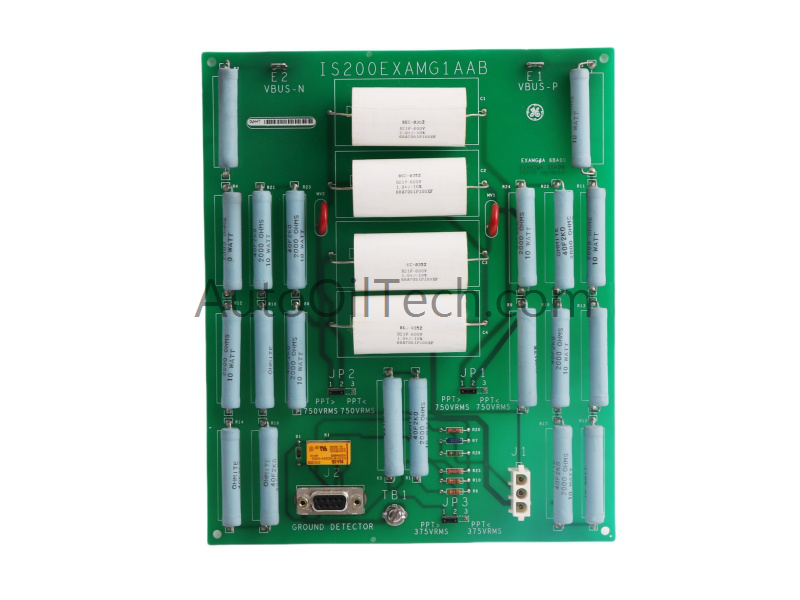
GE Fanuc IS200EXHSG3REC PCB Board
No reviews
In stock!
- Part Number: IS200EXHSG3REC
- Brand: General Electric
- Type: PCB Board
- Dimensions: 11x8.2x1.8cm
- Country of Origin: USA
- Barcode: 8537101190
Share
Product Description
Description
Configured for high-speed relay control in EX2100 Excitation Control Systems, the GE Fanuc IS200EXHSG3REC (IS200EXHSG3 Exciter High-Speed Relay Driver Board) provides direct physical/electrical execution.
Hardware Specifications
| Parameter | Specification |
|---|---|
| Model | IS200EXHSG3REC |
| Brand | GE Fanuc / General Electric |
| Series | EX2100 |
| Product Type | Exciter High-Speed Relay Driver Board (EXHS) |
| Origin | United States |
| Operating Temp | 0 to 60 deg C |
| Relay Configurations | 7 onboard relays (including K41 close, K53A/B flashing, KDEP de-excitation) |
| Contact Input Power | 70 VDC (powered via internal exciter power supply) |
| Interfacing Connectors | 3x 25-pin D-shell connectors (J505, J508, J515) |
| Main I/O Interface | Connects to EMIO (Exciter Main Input/Output Board) |
Backplane Bus and Firmware Compatibility
The board interfaces with the EX2100 backplane network to distribute high-speed drive commands between the EMIO controller cards and the physical trip or flashing circuitry. Operating deterministically across triple modular redundant (TMR) architectures, the module routes separate signaling lanes through dedicated ribbon connections to ensure that firmware flash compatibility matches the master processor timing matrices. All onboard logic processing, state validation, and frame-rate diagnostics for the contactor driver circuitry are tied directly to the system firmware execution rate, preventing asynchronous racing conditions or missing pulse inputs during field-flashing procedures.
Frequently Asked Questions
Q: What is the primary functional role of the 25-pin D-shell connectors on the module? A: The J505, J508, and J515 connectors bridge the EXHS board directly to the M1, M2, and C sections of the Exciter Main Input/Output (EMIO) board. They handle redundant signal transport, though J515 (C channel) does not carry de-excitation and crowbar signals.
Q: How are the contact inputs on the IS200EXHSG3REC wetted and monitored? A: The board utilizes an internal 70 VDC power supply derived from the exciter system to wet three primary contact inputs (41, 53A, and 53B). Their contact feedback status is actively monitored at the system frame rate and mirrored back to the main EMIO processors.
Q: What relays are physically present on this board and what are their specific duties? A: The circuit board hosts seven distinct relays, including the K41 close function contactor drivers (for segments M1, M2, and C), the K53A and K53B flashing pilot relays, and a single KDEP de-excitation pilot relay.
Field Installation Guidelines
- Redundant Interconnection Routine: Ensure the 25-pin D-shell multi-conductor cables are explicitly mated to their designated EMIO ports (J505 to M1, J508 to M2, J515 to C). Cross-wiring these paths will generate immediate hardware incompatibility faults and lock out the TMR configuration.
- Electrostatic Discharge (ESD) Mitigation: The circuit board utilizes high-density surface-mount components alongside physical relay matrices. Technicians must wear a certified, low-impedance grounding wrist strap when unboxing, configuring jumpers, or sliding the board into the slot assembly.
- Wetting Voltage Verification: Before applying primary power, measure the auxiliary contact power nodes to confirm that the nominal 70 VDC wetting voltage is stable and within specification. Ensure that external contact lines are insulated from local chassis ground loops.
- Thermal Sink and Mechanical Seating: Fasten all board-edge mounting screws completely to ensure proper surface contact with the metal support frame. This ensures physical stability and allows the integrated passive heat sink modules to drop thermal loads into the cabinet ventilation airflow path.
Have a Question?